Loading
Loading
Portsmouth, NH · 2026 · Initial Men's 18+ Division
A speed-driven team sport unlike anything on earth. Electric velocity meets elite athleticism. Two balls. Two roles. One winner takes everything.
What is Contravene
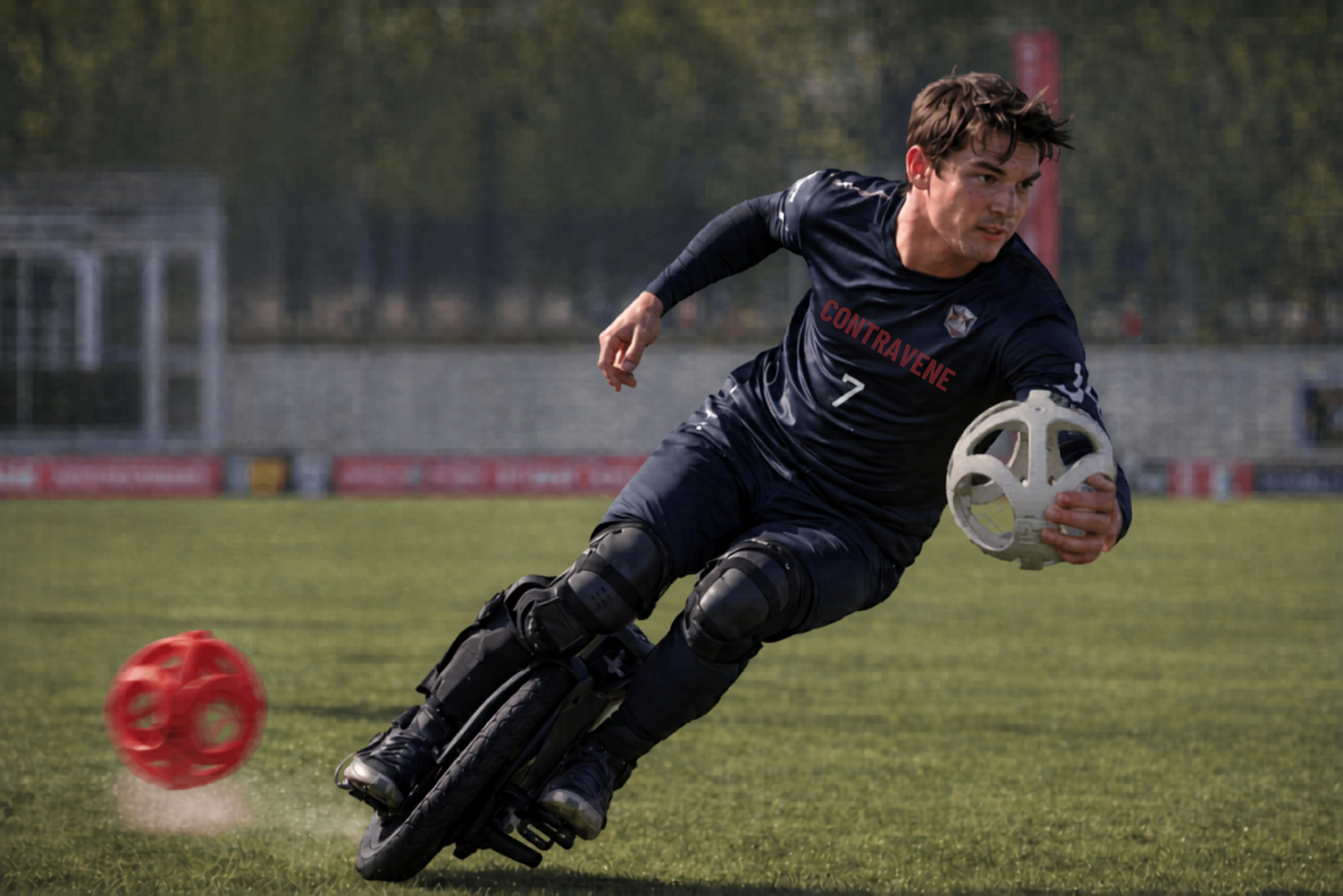
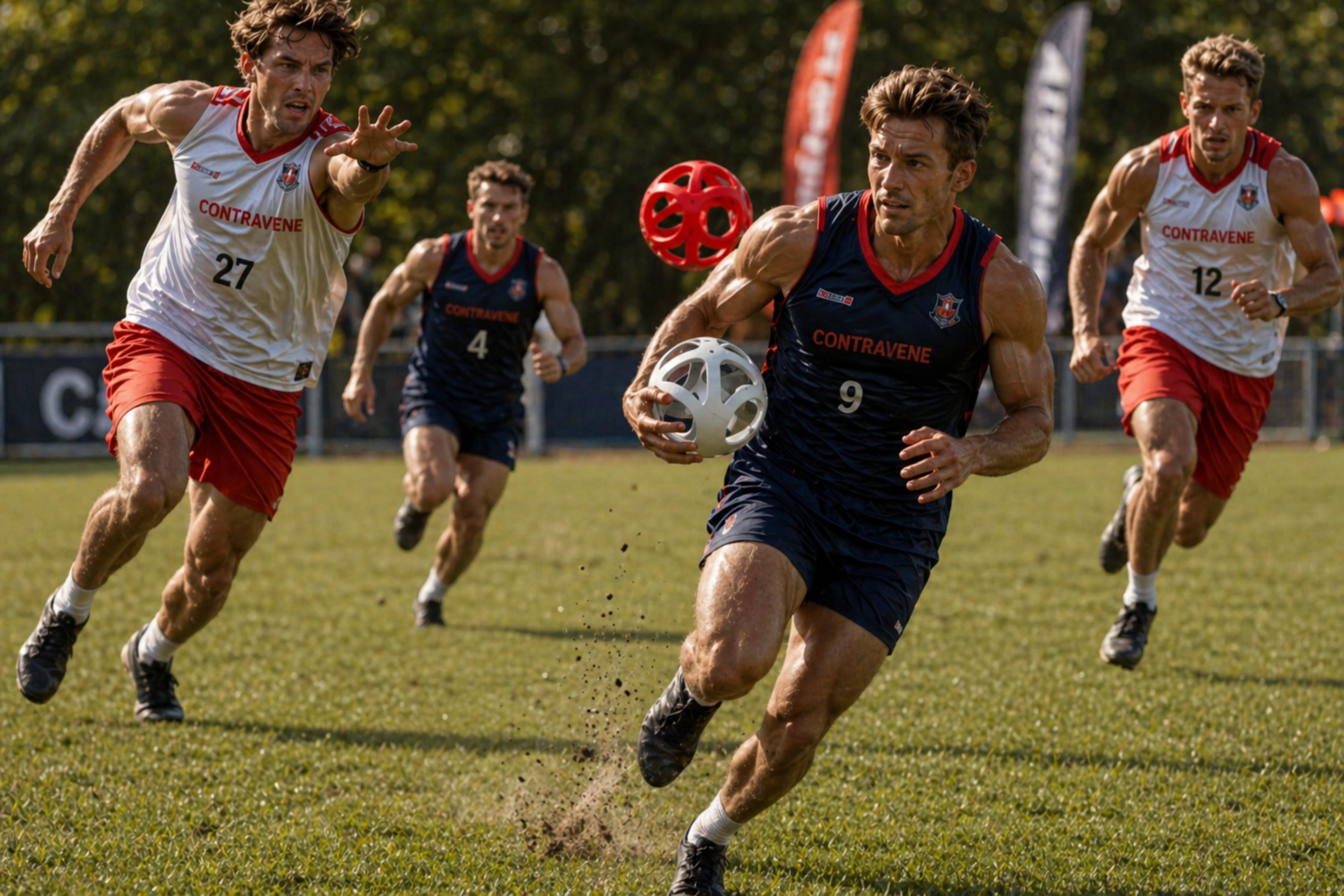
Contravene™ is the original accelerated team sport — and unlike anything that exists. One team attacks with the white Rasp™. One team defends with the red. Each team's Scout commands the perimeter on an EUC while their nine Crew battle on foot in the interior.
Fast. Tactical. Relentless. Engineered from the ground up for a generation that demands more out of sports.
League Contravene™ organizes Contravene™ games, leagues, and tournaments.
The Roles
Two distinct roles. Completely different skill sets. One shared mission — control the field and score.
One per team. The fastest player on any field sport roster.
On offense: every play starts with the Scout's pass-in.
On defense: the closest player to the home arcs.
Up to nine athletes per team. Direct access to every athlete on the field.
On offense: the team's scoring engine — the only role that can reach every arc.
On defense: the force inside the field, with the red Rasp as their weapon.
The Equipment
The Rasp™ appears cubic at some angles, circular at others. It rolls predictably on one axis and resists rolling on the other — how you throw it determines how it behaves.
Interior scaffold with finger grip locations and openings throughout. Designed for possession under pressure — palming, passing, holding at full speed, and one-handed catches.
The white belongs to offense, the red to defense. Contact between them outside the Scoring Arc ends possession instantly.
No other ball behaves like this. Mastering the Rasp — how it moves, how it sits, how it passes — is its own discipline within the sport.
How It Works — 5 Seconds
The Playing Field
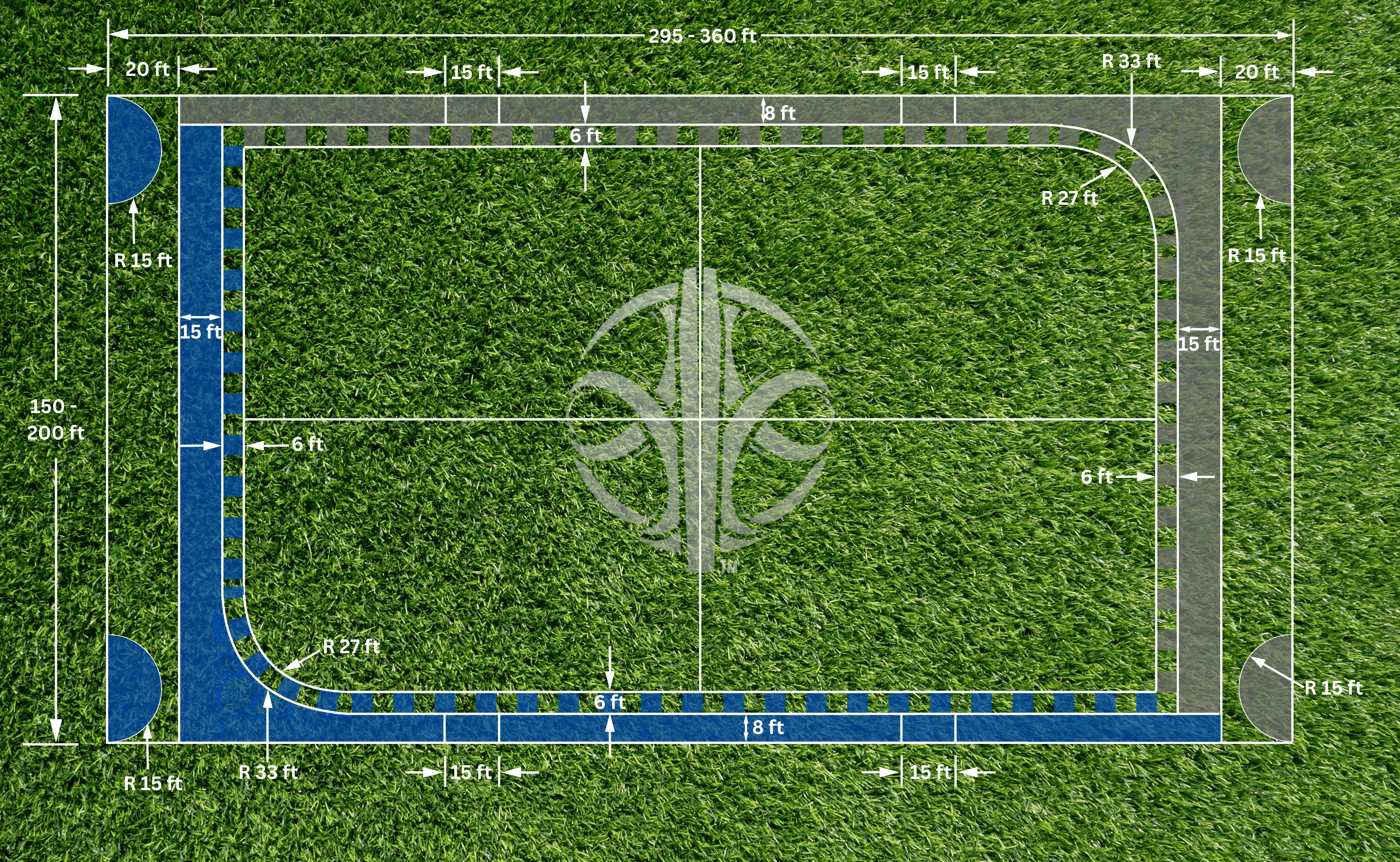
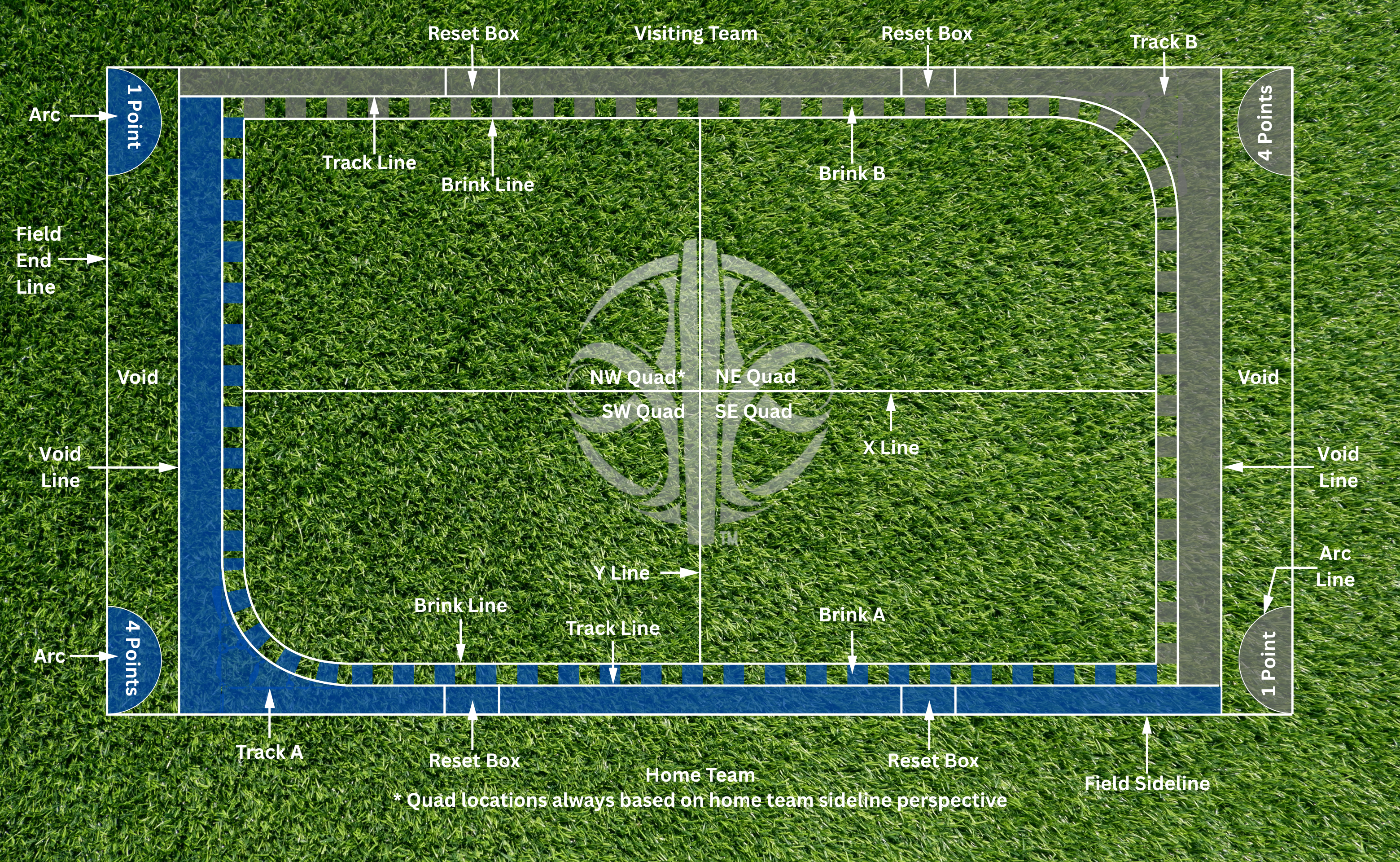
Each Scout operates exclusively on their L-shaped track around the perimeter. Each team's Crew battle in the four quads at the interior. The two zones never overlap — each position owns its territory.
The Tournament
Portsmouth, NH. Real athletes. Real money. Real sport. We're running a series of games where the winning team gets paid — every single game.
Free to join. No entry fee. Just show up, compete, and win.
Winning Team Payout
Contravene™ organized sports games — free to play, waiver required, paid after each game.
Pilot Season — Operational
Portsmouth, NH · Initial Men's 18+ Division · Free to Play
Register to play Contravene™. League Contravene is organizing men's 18+ Contravene™ games in Portsmouth, NH for 2026. Paid after every game. Your shot at the Spoils.
Text "COMPETE" to 603-252-7280
Not sure yet? Text "INFO" to learn more.
Free to play · Paid after each game · Waiver required
Official Documentation
The complete official rulebook for Contravene™. All rules subject to update; the most current version governs play.
The current 2026 rules framework is published below and may be updated before official competition begins.
LIVE: Any white or red Rasp™ that is not spent: (i) any white Rasp eligible for offense; (ii) any red Rasp eligible for defense.
PENALTY RED RASP: A red Rasp, identical in construction to the Prime Red and visually distinguished by two fluorescent-orange bands on each of the four small rings (eight bands total). Awarded to defense for a Rasp Penalty against offense; enters play in addition to the Prime Red and remains with defense until spent or a change-of-control occurs. Only game officials may apply or remove the bands.
PENALTY WHITE RASP: A white Rasp, identical in construction to the Prime White and visually distinguished by two fluorescent-orange bands on each of the four small rings (eight bands total). Awarded to offense for a Rasp Penalty against defense; enters play in addition to the Prime White and remains with offense until spent or a change-of-control occurs. Only game officials may apply or remove the bands.
RED RASP: The ball used by defense to defend against scoring (a.k.a. Prime Red).
SPENT: Any white or red Rasp that is ineligible for play: (i) any white Rasp ineligible for offense; (ii) any red Rasp ineligible for defense.
WHITE RASP: The ball used by offense to score points (a.k.a. Prime White).
ACTIVE PLAYER: Any eligible player currently on the field of play.
CREW: Up to nine active players on each team who may jointly occupy the quads.
ELIGIBLE PLAYER: Any player permitted to participate in a game, set of games, or season, as determined by the league.
INACTIVE PLAYER: Any eligible player not currently on the field of play.
INELIGIBLE PLAYER: Any player not permitted to participate in a game, set of games, or season, as determined by the league.
MAXACTIVE™: The maximum number of active players allowed in a team's crew at a given time; default is nine and is reduced by one for each Bench Penalty.
SCOUT: One active player per team who may both use a wheel and occupy that team's track.
BURST WHISTLE: Three to four short whistle bursts used to indicate a spent-ball event.
LONG WHISTLE: A sustained two-second whistle used to start or stop play and control the game clock.
ARC: The scoring region within each Arc boundary. The Arc boundary line is part of the Arc (line-inclusive).
ARC ATTEMPT: Assigned to a white Rasp the moment it makes contact within the boundary of either Arc.
ARC DEFENSE: A team's responsibility to defend a set of two Arcs from offensive arc attempts.
ARC VALUE: The point value assigned to an Arc based on its distance from the opposition scout's track (near Arc = 1; far Arc = 4).
BENCH PENALTY: A penalty assessed when the opponent already controls a Prime and a Penalty Rasp of that color. Remedy: remove one crew player from the penalized team's active play until the next change-of-control.
CHANGE OF CONTROL: The event in which offense and defense swap roles and dominion over the white and red Rasps; executed by either a launch or a reset.
CONTROL: Team-level dominion over either the white or red Rasps.
DEFENSE: The team in control of the red Rasp at the start of a period of control; remains on defense until a change-of-control is signaled.
FREE: Status of a Rasp not physically possessed by a player of the controlling team; examples include (i) during a pass, (ii) during an arc attempt, (iii) at rest in bounds; free status does not change which team has control.
GOAL: A successful scoring event for offense; awarded under the conditions defined in the Scoring rules.
OFFENSE: The team in control of the white Rasp at the start of a period of control; remains on offense until a change-of-control is signaled.
PENALTY: A designation applied by a game official to an action that meets the penalty criteria; penalties are Rasp Penalty or Bench Penalty.
POSSESSION: Player-level physical custody of a Rasp.
RASP PENALTY: A penalty assessed when the non-penalized team controls only its Prime Rasp. Remedy: award that team one additional, like-color penalty Rasp, governed by the same rules as its Prime counterpart; it remains with that team until spent or a change-of-control occurs.
ARC BOUNDARY: The line demarcating an Arc; the line itself is in bounds for goal adjudication.
ARCS: Four half-circles, two located on each field-end line, where points are scored.
BRINK LINE: The line marking the inner edge of each Brink, where the Brink meets the quad; it forms the vertical plane of the Brink for purposes of plane-break enforcement.
EAST/WEST HALF: The field-half designations used for placement and resets; orientation is fixed for a game and referenced from the home bench vantage.
FIELD-END LINE: The two outermost end boundaries; each extends the width of the field and meets the sidelines.
FIELD OF PLAY: The playable area bounded by sidelines and field-end lines, inclusive of those lines unless stated otherwise.
HOME TEAM BENCH VANTAGE: The reference orientation for labeling quads (NW, NE, SW, SE) and determining east/west halves.
IN BOUNDS: Status of a player or Rasp whose contact (or most recent contact) with the ground is inside the applicable boundary.
OUT OF BOUNDS: Status of a player or Rasp whose contact (or most recent contact) with the ground is outside the applicable boundary.
QUADS: Four equal-sized, contiguous rectangles bordered by Brink Lines, divided by the X line and Y line; labeled from the home bench vantage: (i) northwest (NW); (ii) northeast (NE); (iii) southwest (SW); (iv) southeast (SE).
RESET BOX: Four equal-sized boxes (two within each track, centered to each quad center point) where the scout must begin play after: (i) a non-scoring change-of-control; or (ii) a levied penalty.
SIDELINE: The two outermost lines that run the length of the field and meet the field-end lines.
THE BRINK™: A six-foot-wide buffer running along the inner edge of each track, separating the track from the quads. The Brink absorbs scout and wheel motion (lean, dismount, and runaway-wheel travel) and isolates foot players from high-velocity wheeled play. The Brink is part of the track for Rasp purposes: a Rasp coming to rest within the Brink is treated as resting on that team's track.
THE VOID™: The area bordered by the Void line, field-end line, sidelines, and the Arcs.
TRACK: Two narrow "L"-shaped lanes along the perimeter of the field; the offensive scout and defensive scout have exclusive use of their respective track.
TRACK CORNER: The inner corner where a track turns at the track line; used as a reference for scout movement and pass-back restrictions.
TRACK LINE: Lines extending the length and width of the field from the Void line to the opposing track line; they mark the inner edge of each track and the outer edge of the Brink.
VOID LINE: The line delineating the outer edge of the track and the Void.
X LINE: The line extending the length of the field from one track line to the opposing track line.
Y LINE: The line extending the width of the field from one track line to the opposing track line.
BUSTED DEFENSE™: Designation assigned to defense when they no longer retain control over a live red Rasp, and offense retains control of at least one live white Rasp.
HAND OFF: Exchange of a Rasp between two teammates where the player in possession does not fully relinquish possession before the teammate gains possession.
KICK: The act of intentionally impacting a red or white Rasp below the knee.
LAUNCH: A simultaneous restart used to begin each half and to restart play after points are scored. On the restart whistle, each team's scout races from the reset box on their track to the placement point, retrieves that team's Rasp(s), and must pass-in to the quads before crossing the track corner. During a launch, both teams execute their roles (offense with white; defense with red), while crews hold in their assigned quads until first contact with their team's color.
LIMIT POINT: The exact position on a track marked by a spent Rasp or scout limit flag that the limited scout may not pass.
OBSCURING: The act of one or more offensive players intentionally attempting to obscure from view a teammate in possession of a white Rasp from a defensive player who is in possession of a red Rasp.
PASS: Exchange of a Rasp between two teammates where the player in possession fully relinquishes possession before the teammate gains possession; a legal pass includes any type of player-to-player exchange not expressly prohibited.
PASS-IN: The act of a scout delivering their Rasp into a quad; a Rasp is considered passed in when it has been released by the scout and is either touched by a teammate or makes contact with the ground within any quad.
PASS-IN LOCATION: The position from which a scout is permitted to deliver a Rasp into the quads during launch or reset.
RESTART LOCATION: The specific reset box or track position where a scout is placed for a restart and which the scout may not pass before pass-in.
SCOUT LIMIT: Tactic employed by a team to limit the track area their opponent's scout may access.
SCOUT-LIMIT FLAG: The flag placed by officials to mark the limit point when a scout limit is established.
SELF-PASS: The act of regaining possession of a white or red Rasp by the player last in possession of it.
SPENT-BALL EVENT: Any occurrence that causes a Rasp to be designated spent under the spent-ball rules.
WHEEL: A single-wheeled electric vehicle a scout may elect to employ.
ACTIVE: Designation applied to any running clock or count (game clock, five-count, twenty-count).
FIVE-COUNT: A five-second count administered by a game official upon an arc attempt, used to adjudicate goals. The five-count is inactive during a busted defense.
GAME CLOCK: Clock administered by a game official that marks the beginning and end of the game, inclusive of overtime.
HALFTIME: A continuous fifteen-minute intermission beginning immediately after the first half and ending immediately prior to the second-half start.
OFFICIAL TIMEOUT: A two-minute stop ordered by game officials for administration (including pre-overtime) or at their discretion.
OVERTIME: Game-clock designation applied at the conclusion of standard time when the score is tied.
STANDARD TIME: Game-clock designation applied during non-overtime play; regulation consists of two thirty-minute halves (excluding official stoppages) and a fifteen-minute halftime.
TIMEOUT: A stoppage of the game clock and cessation of play for both teams; each timeout period is one minute.
TWENTY-COUNT: A twenty-second count that begins when a busted defense occurs and limits the time available to offense before a change-of-control.
The white and red Rasps are:
Penalty Rasp Identification — Fluorescent Bands: To make penalty Rasps unmistakable during live play, each penalty-designated Rasp is fitted with high-visibility markings as follows:
Field length and width may vary within a specified range. All other field dimensions are fixed and may not be altered, except where a field-width or field-length change requires proportional adjustment.
A Rasp is designated spent when its movement stops within the Void.
Players may not make physical contact with any Rasp that touches the ground within the Void.
At any time during an official game, each team may field at most ten eligible players: one scout and up to nine crew (subject to adjusted MAXACTIVE).
Each team must field at least one eligible player at the scout position and at least one eligible player at a crew position.
Each team must adhere to the adjusted MAXACTIVE as determined by game officials (e.g., reductions from Bench Penalties).
Each team must designate one or two eligible players as team captains and communicate their names to game officials before play begins.
If a team is left with no captain due to removal, injury, or any other cause, a replacement must be designated and reported to game officials before the next event that requires captain input.
All rules on game timing, advancing the ball, scoring, player exchanges, penalties, possession and control, and substitutions apply uniformly to all players and player positions unless a rule expressly provides otherwise.
Position-specific rules (e.g., scout track exclusivity and wheel use; crew quad/track-plane limits) supersede general rules where they conflict.
Any exception to uniform application must be stated explicitly within the relevant section for that position or rule.
Each team may designate at most one active player as the scout.
The scout competes alone and exclusively on that team's assigned track.
When directed by game officials, the scout has sole authority to pass their team's Rasp into play.
The scout has sole authority to use a vehicle ("wheel") that meets league criteria.
The scout may break the vertical plane of the Brink (e.g., to lean during cornering or extend the body across the boundary) but may not make ground contact within the Brink — by wheel, foot, or any other part of the body.
Each team may field up to nine active crew who compete together exclusively within the quads.
Crew may not reach into — or break the vertical plane of — any Brink or any track (their own or the opponent's).
A game official sounds a sustained two-second whistle to start or stop play. When used to start play, the game clock starts and play begins. When used to stop play, the game clock stops and play ends.
While indicating the player or ball location, a game official sounds three to four short whistle bursts to signal a spent ball. If the spent ball remains in bounds, the official throws a flag near the ball to mark its status.
Official call format (spent-ball): To ensure fast, unambiguous communication in multi-ball play, officials use the following standardized call:
Officials and the scorer's table may echo the verbal call for clarity. The existing requirements to abandon a spent Rasp, avoid interference, and respect flag markers remain in effect. The flag and the spent ball remain in place until a game official removes them.
One-at-a-time: When defense is not busted, only one white Rasp may attempt to score at a time.
Overlap is illegal: If a five-count is active for a white attempt, any second white that contacts either Arc line or interior during that same five-count is illegal.
Effect: The intruding white is immediately designated spent and removed from consideration for that sequence.
Definition & trigger: A five-count is a five-second count administered by a game official, triggered the instant a white Rasp begins an arc attempt by making contact within the boundary of either Arc.
Defender's negation window: During the five-count, defense may negate the attempt by striking the white with a red such that the white fully exits the Arc boundary before the count expires.
Cancellation (unsuccessful attempt): The five-count is canceled (no goal) if, before five seconds elapse, the white exits either Arc boundary for any reason, or is otherwise rendered spent under the spent-ball rules.
Clock precedence: An active five-count supersedes other clocks; if another clock would expire during the five-count, play continues to adjudicate the attempt, then the other clock's consequences apply.
Goal signal: If five seconds elapse with the white remaining within either Arc boundary (line is in-bounds), the official signals goal. Points, once awarded, are not withdrawn due to subsequent activity inside the Arc.
Twenty-count governs: When defense is busted, a twenty-count starts and governs play until resolution or expiry.
Exclusivity suspended: More than one live white may attempt to score at the same time (maximum two). The normal overlap restriction does not apply.
No auto-spend on entry: A white that contacts either Arc while another white's five-count would otherwise be active is not illegal and is not automatically spent.
Arc-settle scoring (line-inclusive): Any live white that comes to rest with all contact points on or inside either Arc is awarded a goal immediately (the Arc line is inside). Prior goals stand.
Concurrent resolution: The twenty-count continues until all live whites are resolved — each either awarded a goal by arc-settle or designated spent by the normal spent-ball rules — or the twenty-count expires. If both whites meet the arc-settle condition while the twenty-count is still active (i.e., before the twenty-count expiry signal), award both goals and end the twenty-count; this stands even if the expiry whistle follows a moment later.
At expiry: When the twenty-count expires, apply the outcome simultaneously to every remaining live white: any possessed white becomes spent, and any free white whose movement has stopped outside either Arc becomes spent.
Penalty during twenty-count: A penalty called during an active twenty-count does not suspend or reset the twenty-count; the count continues through the penalty stoppage and any goals awarded before or during the stoppage stand. The penalty outcome is administered immediately following the conclusion of the twenty-count and its associated change-of-control procedure.
Goals stand: Any goals already awarded remain awarded.
Upon an official's safety signal, the clock stops for up to 120 seconds for evaluation. Substitutions are permitted. The injured player may not re-enter until cleared by a game official. Restart from the prior restart location and count.
Scout injury: If the injured player is the scout, the following applies:
The game clock starts and stops only when designated by a game official's long whistle. Events that start or stop the clock include: start of each half; halftime; timeouts; penalties; injuries; scored points that cause a change-of-control when no live white Rasps remain; start and conclusion of overtime; and any other interruption deemed necessary by game officials.
A game of Contravene consists of two thirty-minute halves. Halftime is a fifteen-minute intermission beginning at the conclusion of the first half and ending at the start of the second half.
At the expiration of regulation time, the team with the higher score is declared the winner. If the score is tied at the end of regulation, a two-minute game-official timeout is followed immediately by overtime.
Timing corrections: If the visible game clock, horn, or count display fails or conflicts with an official audible count, the Referee-in-Charge corrects timing by a reasonable estimate; five-count and twenty-count rulings prevail over displayed time.
External interference: For weather, field failure, or spectator interference, suspend play and resume from the last restart location with the same placements and counts in effect.
If the score is tied at the end of the second half, an overtime period is required. Each overtime period is 10 minutes. All standard rules apply to overtime unless otherwise stated.
During the two-minute game-official timeout preceding overtime, a coin toss is held at midfield with a designated captain from each team present. Before the toss, the visiting captain calls "heads" or "tails." A game official tosses the coin; it must be uninterrupted and land directly on the field. If the visiting team's call matches the result, that captain chooses to start overtime on offense or defense. If the call does not match, the home captain makes the choice.
When the overtime clock expires, the team with the higher score is declared the winner. If the game remains tied after an overtime period, the process repeats: a two-minute timeout followed immediately by another 10-minute overtime. In each subsequent overtime, the team that did not start the prior overtime on offense starts on offense. Overtime periods continue until one team leads at the expiration of the overtime clock.
A twenty-count is a twenty-second count used to prevent an unopposed team from running down the clock. The twenty-count begins the moment a busted defense occurs and is the time afforded to offense to score with any white Rasp before a change-of-control.
Upon expiration of the twenty-count, the spent designation is applied to (i) any free white Rasp whose movement has stopped outside either Arc boundary and (ii) any possessed white Rasp.
During a busted defense, an active twenty-count is canceled early and change-of-control procedure is followed if the only remaining live white Rasp is designated spent or is ruled a goal via a valid arc attempt.
The objective of offense is to score within the Arcs defended by their opponent. The Arc nearest the opposition scout's track is worth one point; the Arc furthest from the opposition scout's track is worth four points.
Each Arc is a safe harbor for white Rasps: contact between a red Rasp and a white Rasp within an Arc does not cause the white Rasp to be designated spent.
Offensive arc attempts may not overlap except when offense faces a busted defense. Rasps that come to rest within an Arc remain in the Arc and are not disturbed by officials until a change-of-control occurs.
A preexisting white Rasp already within an Arc may be contacted by a subsequent arc attempt, provided the subsequent white Rasp did not enter while a preexisting five-count was active.
Once awarded, points are not withdrawn due to subsequent activity inside an Arc; after a goal signal, the points stand even if the scoring Rasp is later moved outside the Arc.
Only the portion of the white Rasp in physical contact with the field is considered when judging whether it is within either Arc boundary for a valid goal.
An offensive goal is determined only when all of the following are satisfied:
Determination instant:
Signal lag (points stand): Once a goal is awarded, any subsequent contact or movement — including a red Rasp striking the white and pushing it out before the official's whistle/hand signal — does not cancel the goal. The scoring white is spent by score.
Pre-determination movement: Before the determination instant, if the white exits either Arc for any reason, it is spent.
Administrative signal: The official's whistle/hand signal confirms the ruling but does not create the score; rulings are keyed to the determination instant.
Tie/Simultaneity standard (Non-Busted Defense): If the white's complete exit from the Scoring Arc and the expiration of the five-count appear simultaneous, award the goal. Defense must force a full exit before the count expires; ties favor the attempt.
Red and white Rasps are governed by the same field boundaries. A Rasp that contacts any area outside the sidelines or field-end lines is out of bounds and spent. Contact between like-colored Rasps (red–red or white–white) is permitted, and any resulting change in path is honored by officials. The boundary lines are in bounds unless otherwise stated.
When used: Start of each half; after any change-of-control that results from points being scored.
Designation at launch (both teams): A launch is the simultaneous restart procedure for both teams. The team in control of the white Rasp(s) is designated offense; the team in control of the red Rasp(s) is designated defense. Both teams execute the launch.
Rasp placements: Place each team's Rasp(s) at the intersection of the track line and the X line on that team's assigned track for the half (or the assignments in effect after scoring).
Starting positions — scouts: Within their respective tracks, each scout starts in the reset box furthest from that team's track corner (the box opposite the placement). On the long-whistle restart, each scout races to the placement point, retrieves their Rasp(s), and must pass-in before crossing the track corner. After pass-in, the scout may move freely within the track.
Starting positions — crews:
Pass-back restriction (scout): After first contact and before pass-in is complete, a scout may not cross the track corner. Once pass-in is complete, a Rasp may not be passed back to the scout until the scout has traveled beyond their track corner.
Offsides (launch): Before pass-in is complete: a scout who crosses the track corner; a scout who leaves the reset box early (before the whistle); or any crew who leave their assigned quads early — each commits Offsides (Launch).
Timing: There is no maximum time to pass-in during a launch, except as limited by the game clock and any active twenty-count.
Use of a wheel is optional: a scout may operate a league-approved wheel that meets all of the following:
When a scout is mounted on or actively controlling their wheel, the wheel is considered an extension of the scout's body and all rules apply uniformly to scouts with or without a wheel.
Unless otherwise stated, a scout on offense and a scout on defense may move freely — at any time, in any direction — within the position's established boundary and track assignment, subject to timing and procedure rules.
Scout position, movement, and timing are further governed by the game's timing and procedures, penalty procedures (including calling, during-launch, and reset penalties), launch mechanics, the scout limit tactic, and change-of-control procedures (launch or reset).
The Brink: The scout may break the vertical plane of the Brink to accommodate cornering lean, body extension, or arm reach but may not make ground contact within the Brink — by wheel, foot, or any other part of the body. A wheel contact patch, scout's foot, or scout's body touching the ground within the Brink during normal play is a Boundary violation.
Fall, dismount, or loss of control: A scout fall, dismount, or loss of control of the wheel does not, by itself, stop play. If the fall results in scout or wheel ground contact outside the scout's permitted area, a Boundary violation is assessed under Penalty Descriptions. If the fall results in injury, the standard Injury Timeout procedure applies. Travel of an unattended wheel outside the scout's permitted area is treated as scout ground contact in that area for purposes of the Boundary violation.
Crew may move freely — at any time and in any direction — within the position's established boundary, subject to game timing and procedure rules.
Crew must remain within the quads and may not enter or break the vertical plane of any Brink or any track.
Crew position, movement, and timing are further governed by the game's timing procedures, penalty procedures (including calling, during-launch, and reset penalties), launch mechanics, the scout limit tactic, and change-of-control procedures — using a launch after scoring or a reset when no points were scored.
Scout fall — crew response: Crew remain subject to the standard prohibition on entering or breaking the vertical plane of any Brink or any track under all circumstances.
On a neutral field, a game official designates a home team by coin toss before play begins. To begin the first half: the visiting team starts on offense with control of the white Rasp, and the home team starts on defense with control of the red Rasp. At the start of the second half, each team is assigned the opposite set of Arcs and track from the first half. To begin the second half: the home team starts on offense with control of the white Rasp, and the visiting team starts on defense with control of the red Rasp.
Offensive control and possession apply only to white Rasps. Offensive players may not intentionally interact with any red Rasp: no touching, kicking, possessing, carrying, or intentionally altering its path. Incidental, non-advantage contact may be disregarded at the game official's discretion.
Any offensive player may simultaneously possess Prime and/or Penalty White Rasps.
The team designated as offense retains control while at least one live white Rasp remains (whether free or possessed). Offense ends when the team's last remaining white Rasp becomes a goal, is designated spent, or is subject to the expiration of the half or game.
Obscuring is prohibited: offensive players may not act individually or in coordination to obscure a teammate in possession of a white Rasp from a defensive player in possession of a red Rasp.
Defensive control and possession apply only to red Rasps. Defensive players may not intentionally contact a white Rasp with their body or equipment; intentional interaction with a white Rasp must occur only by striking it with a red Rasp. Incidental, non-advantage contact may be disregarded at the game official's discretion.
The team designated as defense retains control while at least one live red Rasp remains — whether free or possessed. Defensive control ends when (i) a change-of-control is signaled, or (ii) no live red Rasps remain (all are spent or otherwise removed from play).
A scout limit may be employed by either team. Based on the location of an opponent's Rasp that comes to rest on the track, the opponent's scout is restricted to a portion of their track (may move freely up to, but not past, the limit point).
A scout limit is established only when all of the following are true:
To execute a scout limit, a team sacrifices a live Rasp by causing it to come to rest on the opponent's scout's track (e.g., by pass or deflection such that it stops on the track). Any Rasp that satisfies the scout limit criteria above is, by default, designated spent.
While a scout limit is in effect, the limited scout may move freely within their track up to the limit point (the position of the spent Rasp or the scout limit flag) but may not travel beyond it. The position of the spent Rasp or scout limit flag used to mark the limit must not be intentionally altered by any player. The scout limit designation remains in place until a change-of-control occurs.
When all criteria in Section 12.01 are satisfied, a game official sounds a long whistle and stops the clock. A game official replaces the scout limit Rasp with a flag at the exact location of that Rasp and removes the scout limit Rasp from play.
When placement is complete, a game official sounds a long whistle to restart play and the game clock. From that signal, each scout, at a time of their choosing, must pass-in their respective Rasp(s). Each scout may move within their track to complete the pass-in but may not move beyond their restart location until their Rasp(s) have been passed in. The pass-in process is not time-limited, except as governed by Timing & Game Procedures.
This procedure applies to all Rasps — red or white, possessed or free. When a spent-ball event occurs, one or more game officials sound the burst whistle and indicate the location of the spent ball.
Failure to abandon or interference with a spent Rasp after it has been called and communicated by a game official is penalized under Section 14.06 — Penalty Descriptions.
A white Rasp is designated spent if:
Plane only: Crossing (breaking) the vertical plane of a field boundary without ground contact does not by itself cause a white Rasp to be designated spent.
A red Rasp is designated spent if:
Plane only: Crossing (breaking) the vertical plane of a field boundary without ground contact does not by itself cause a red Rasp to be designated spent.
A change-of-control occurs only on an official long-whistle stoppage. It swaps team designations (offense ↔ defense) and dominion over the white and red Rasps. A change-of-control is executed by either a launch or a reset.
Triggers: end of a half (designations swap at the start of the next half); or the team's last remaining live white Rasp becomes a goal or is designated spent (including by twenty-count expiry).
Use the launch for a change-of-control when points were scored by offense during the preceding period of control. The launch is identical to the start-of-half launch described in Section 10.02. If a launch is not required, the change-of-control begins with a reset.
Use the reset procedure for a change-of-control when no points were scored during the preceding period of control.
Reset anchor & placements:
When placements are complete, a long whistle restarts play and the game clock; any active counts resume per timing rules. The pass-in process is not time-limited, except as governed by Timing & Game Procedures.
Penalties apply equally to offense and defense unless a rule specifies otherwise. Any penalty listed in Section 14.06 — Penalty Descriptions may be levied by any game official.
Rasp Penalty criteria: when a team is penalized and the opponent controls only a Prime Rasp, the penalty is a Rasp Penalty.
Rasp Penalty effect: The non-penalized team is awarded a penalty Rasp identical in color to that team's Prime Rasp, visually distinguished by two fluorescent-orange bands on each of the four small rings (eight bands total). The penalty Rasp is governed by the same rules as its Prime counterpart.
Penalty Rasp control: once awarded, a penalty Rasp remains with the awarded team until either a change-of-control occurs or that Rasp is designated spent.
Bench Penalty criteria: when a team is penalized and the opponent controls both a Prime and a Penalty Rasp (the maximum permitted), the penalty is a Bench Penalty.
Bench Penalty effect:
Bench Penalty duration: the reduced MAXACTIVE remains in effect until a change-of-control occurs, at which point the team is restored to the default MAXACTIVE of nine.
Substitutions during Bench Penalty: standard substitution rules apply within the reduced MAXACTIVE, including the eligibility of the removed player to re-enter via substitution.
Successive Bench Penalties: for each additional Bench Penalty assessed before a change-of-control, repeat the MAXACTIVE reduction and one-crew removal steps.
Delay enforcement: If a team assessed a Bench Penalty fails to remove a crew player before play resumes, the officials may assess delay of game.
Concurrent penalties: If both teams are penalized — whether for the same sequence or separate actions — the penalties do not offset. Each team is penalized independently according to the opponent's current ball status: Rasp Penalty if the opponent controls only its Prime Rasp; Bench Penalty if the opponent already controls both a Prime and a penalty Rasp. Remedies are applied separately to each team on the same stoppage.
Score nullification: any arc attempt by a penalized team that officials determine was achieved as a direct result of a committed penalty is immediately nullified.
No team may control more than one prime and one penalty Rasp of a given color at any time. A penalty Rasp is governed by the same rules as its paired prime Rasp and remains live until designated spent under Section 13.02 (Spent Ball Events — Offense) or Section 13.03 (Spent Ball Events — Defense).
A penalty called during a launch is handled on an immediate long-whistle stoppage; officials then determine the penalty level (Rasp Penalty or Bench Penalty) and apply the corresponding remedy.
If a Rasp Penalty, a penalty Rasp of like color is awarded to the non-penalized team; if a Bench Penalty, the penalized team's MAXACTIVE is reduced by one and one crew player is removed before play resumes.
After remedies are applied, play restarts with a full launch. Officials re-place all Rasps at the launch placement points, update player counts and team designations to reflect the penalties, re-establish all launch positions and constraints, and restart on the long whistle.
On the restart signal (long whistle), scouts may retrieve and must pass in their Rasp(s) per launch; they may not travel beyond their permitted location until pass-in is completed. The pass-in process is not time-limited except as governed by Timing & Game Procedures.
If penalties are assessed to both teams during the launch, concurrent penalties do not cancel; officials apply each team's penalty based on its status (Rasp Penalty or Bench Penalty) and then restart the launch.
A penalty is called by long whistle during live play when the teams are not engaged in a launch, and play is stopped. Officials determine the penalty level (Rasp Penalty or Bench Penalty) and apply the corresponding remedy per Penalty Criteria.
If a Rasp Penalty, a penalty Rasp of like color is awarded to the non-penalized team; if a Bench Penalty, the penalized team's MAXACTIVE is reduced by one and one crew player is removed before play resumes.
An official provides the offensive scout with the white Rasp and, if applicable, the Penalty White within the reset box assigned to the quad where the penalty occurred. An official provides the defensive scout with the red Rasp and, if applicable, the Penalty Red within the reset box opposite the offensive scout's box. After placements are complete, officials follow the standard reset procedure.
Adjudication standards, indicators, and restart/score guidance are summarized in Appendix F — Penalty Matrix & Adjudication Notes. Penalty level is determined situationally per Appendix F.0 — Global Standards.
(a) General. Player substitutions are permitted only when the game clock is stopped and must be approved by a game official before the substituting player enters the field.
(b) Request procedure. A substitution is requested by the coach or an active player of the substituting team. The request must be communicated to the nearest game official by verbal signal or raised hand before the restart whistle. Substitutions may not be requested during an active five-count or twenty-count, or during any period where the rules require immediate restart.
(c) Entry and exit procedure. The exiting player must be fully off the field of play before the entering player steps on. Any overlap that creates a momentary roster above the current MAXACTIVE is subject to penalty under Illegal Substitution. Officials shall confirm the roster count before signaling the restart.
(d) Scout substitution. The scout position may be substituted in the same manner as any crew position, subject to the following:
(e) No limit on substitutions. There is no limit on the number of substitutions per game, per half, or per stoppage, except as constrained by the current MAXACTIVE.
(f) Ineligible player. A player who is ineligible (suspended, un-rostered, or otherwise barred) may not substitute in.
(g) Return from injury. A player removed for an injury timeout evaluation may not re-enter until cleared by a game official. This restriction applies regardless of clock status.
Obscuring. Threshold = intent/reckless and material advantage. Examples: lateral shuffle into sightline during a five-count; body screen; timed slow-down forcing defense to reroute. Not obscuring: <~1s incidental cross with no advantage.
Offsides (launch/reset). Any pre-pass-in breach by scout/crew → offsides; nullify impacted play; launch if the infraction occurred during a launch; otherwise Reset.
Interference (spent ball). Any player touching/moving a clearly spent ball or its flag/marker → interference.
Illegal contact. Prohibited contact or defender touching a possessed white; contact with a free white must be via a red.
Dimensions for reference; official tolerances published separately.
See Section 3 — Field Markings & Measurements for the labeled and measurements diagrams.
Brand · IP · Community Use
Contravene™ is a new accelerated team sport. We want it to grow — and we want the people who help it grow to know exactly where the lines are.
Play it casually. Talk about it. Share your own short clips. If you want to organize a league, run an event, sell merch, manufacture Rasps, teach the rules publicly, or upload our official footage, get in touch first. Everything else lives in between, and the sections below explain how to think about it.
Contravene™ is the name of our specific game, ruleset, and brand. Accelerated team sport is the category it belongs to.
Contravene is our original contribution to the accelerated team sport category, and we expect others to follow. The category is open. The brand is ours. When discussing the category, use accelerated team sport. When discussing our specific game, ruleset, equipment, official events, or league, use Contravene or League Contravene.
Trademarks. Contravene™, League Contravene™, Rasp™, and Contravene Spoils™ are trademarks of League Contravene LLC, asserted under common-law trademark rights.
Patents. The Rasp™ ball and related equipment are protected under U.S. Patent Nos. 10,806,971 and 11,458,371. Additional patents may be pending.
Copyright. The official Contravene rulebook, field diagrams, photography, video, broadcasts, illustrations, website copy, and visual identity are © League Contravene LLC.
Play casually with friends. Pickup games among friends, with no public promotion, no recurring schedule, no fees, no team names, no use of our logos, and no official-looking branding — that's just sport. Go play.
Talk about Contravene. Articles, podcasts, blog posts, social media, commentary, criticism, news reporting, and general discussion all welcome. We don't police normal conversation. You can talk about what Contravene is; you cannot publish your own "how to play Contravene" guide or rule explainer without permission.
Share your own short clips. If you're a player or attendee at a Contravene event, you can post short, non-monetized clips of yourself — generally under sixty seconds, without our logos or broadcast graphics, and not titled, edited, or presented in a way that makes it look official.
Link to the official rules. Just link to leaguecontravene.com rather than republishing the rulebook elsewhere.
Anything more organized than casual play requires a license — including non-profits, schools, and community groups. We know that sounds restrictive, and we don't take the position lightly. We've taken it because Contravene is a new sport and consistency in how it's played and represented matters more right now than maximum convenience for organizers. The license exists to make sure organized groups understand they're representing the sport. It's typically a conversation, not a fee.
The following all require a written license:
If you're trying to organize anything that fits in this list, the path forward is short: send us a note and we'll talk.
Official Contravene games, highlights, clips, broadcasts, and channel branding belong to League Contravene. We're investing heavily in the official channel and we intend it to be the canonical source.
Allowed: Reaction videos, commentary, criticism, news reporting, general discussion about the sport, your own short non-monetized clips of unofficial play or your own performance, and personal accounts identifying you as a player.
Not allowed: Channels or video titles formatted to look official ("Official Contravene Highlights," "Contravene Game 1 Full Match," "Contravene Network Episode 1"); reposted official footage; monetized highlight compilations; full-game recordings; livestreams of our events; and unofficial "how to play" videos, rule summaries, translated rules, abridged rules, or instructional diagrams using the Contravene name. The official rulebook is the only canonical source for the rules while the sport is new.
The Rasp™ is patent-protected and central to the integrity of the game. Sanctioned and licensed play uses official Rasps. Other organized play of any kind requires our written permission, including approval of equipment. Manufacturing, selling, importing, or commercially distributing Rasp™ game balls or game balls likely to be confused with official Rasp™ equipment requires a written license — and our posture on equipment licensing is restrictive by design.
Athletes who play in League Contravene events sign a participation agreement that grants us full media and likeness rights to the event. Spectators consent to being recorded by entry. Both can take personal photos and short non-commercial clips. Neither can livestream, sell, monetize, or broadcast event footage without permission.
Our default is education and friendly correction, not legal action. Most issues we encounter — fans using the wrong name format, a few players using an unintentionally official-sounding name for casual pickup, a creator who misunderstood the rules — get resolved with a friendly note. We reserve formal action for the cases that genuinely matter: counterfeit Rasps, channels impersonating official League Contravene, monetized reposts of our footage, and unauthorized commercial use of the brand.
If you've gotten a takedown or correction request from us and think it's wrong, write to legal@leaguecontravene.com. We'll review timely disputes in good faith.
Contravene is a contact sport involving projectile equipment, electric unicycles at speed, and physical play. We make no warranties about the safety of casual or unsanctioned play — anyone playing outside of our sanctioned events does so at their own risk. We strongly recommend protective equipment, qualified supervision, medical readiness, signed waivers, and insurance for any organized play.
In particular, the electric unicycle component creates risks distinct from traditional field sports: do not attempt EUC-based play without appropriate riding skill, protective gear, and clear separation between EUC riders and other players.
This page is the practical summary. The full Community Use & IP Guidelines is the authoritative document — it covers definitions, license categories, enforcement procedures, athlete waiver provisions, and the legal mechanics. Both documents are governed by New Hampshire law.
Licensing, partnerships, and IP inquiries:
legal@leaguecontravene.com
Press, media, and broadcast partnerships:
media@leaguecontravene.com
Community Use & IP Guidelines · Version 1.0 · Effective May 1, 2026 · Published by League Contravene LLC